Nut Sort: Color Sorting Game
- 4.8
- Rating
- 10.00M
- Installs
- Free
- Price

 Analysis by App-foxy
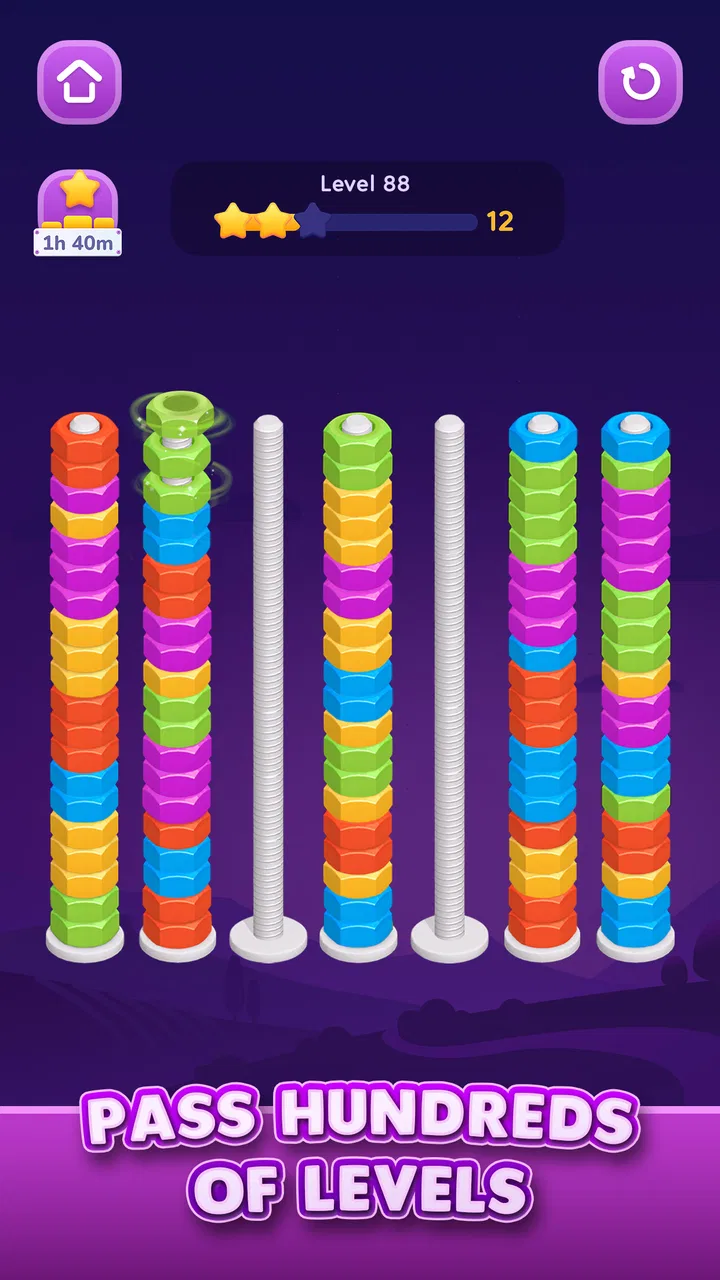
I picked up Nut Sort: Color Sorting Game expecting a simple way to fill a few spare minutes, and that is exactly where it works best. The idea is easy to understand almost immediately: colored nuts need to be moved onto matching bolts until each bolt contains one color. There is no long tutorial to study and no complicated story to follow. I can start a puzzle, make a few decisions, and feel that small satisfaction of bringing a messy board into order.
That simplicity is the game’s strongest quality, but it also sets a clear limit. This is not a puzzle adventure built around surprises, characters, or deep progression. It is a focused sorting game from Tripledot Studios Limited, aimed at players who enjoy tidy visual patterns and short bursts of concentration. In my experience, it is most enjoyable when I treat it as a small mental break rather than a game I need to play continuously for a long stretch.
Why the first few puzzles feel so approachable
The opening appeal comes from the directness of each move. I look at the available colors, identify a useful destination, and tap to transfer a nut when the rules allow it. The board communicates the objective visually, so I do not need to remember a complicated set of instructions. That makes the game comfortable for someone who rarely plays mobile puzzles, while still giving experienced players a familiar sorting challenge to settle into.
You May Also Like

 Blood Strike: 2.5 Anniversary
Blood Strike’s Loadouts Turn Every Drop Into a Tactical Gamble
A close look at Blood Strike’s custom loadouts: how fast access to signature weapons reshapes its battle royale rhythm, rewards preparation, and narrows the gap between fights.

 Pandora - Music & Podcasts
Pandora’s Music Is Easy to Start, but Harder to Recover
Pandora’s strength is its low-effort path from a seed to a station. Its weak spot is how much confidence it asks you to place in connection, setup, and quiet recovery.

 8 Ball Pool
 Is Built on Rivalries, Rematches, and Routine
A close look at the rivalries, rematches, shared routines, and unanswered safety questions that turn a quick pool match into a persistent mobile community.

 Samsung Music
’s Quiet Strength Is Playing What You Already Own
Its reach comes less from spectacle than from dependable access to a personal library. That simplicity is both the app’s strongest retention engine and its ceiling.

 AccuWeather: Weather Radar
AccuWeather Review: A Quick, Clear Forecast for Everyday Decisions
For everyday plans, the best forecast is the one you can understand quickly. AccuWeather makes rain timing, radar, and local conditions easy to act on, with a few trade-offs.

 Hill Climb Racing
Why Hill Climb Racing Still Turns Crashes Into One More Run
A tiny car, a bumpy hill and one more upgrade: Hill Climb Racing keeps resurfacing because its simple chaos makes every near-miss feel personal.
More From Our News Desk



The pleasure is less about speed than about avoiding a bad arrangement. A move can look helpful because it exposes a color underneath, yet it may also block the space needed later. That gives the game a modest layer of planning without making every level feel like a demanding logic exam. I like that balance for casual play: I am thinking ahead, but I am not required to maintain a large chain of calculations in my head.
The store summary describes the central action plainly, but the practical appeal is in the rhythm of cleaning up the board. At the beginning of a puzzle, the colors can feel visually tangled. As I make sensible transfers, the position becomes easier to read. The final matching groups provide a clear sense of completion, especially when I have rescued a board that initially seemed awkward.
Because the game is free, it is easy to try without treating the first session as a commitment. It is rated for Everyone, which fits the uncomplicated presentation and accessible rules. The game has also attracted a 4.8 average from around 670 thousand ratings, with more than 10 million installs, so it clearly appeals to a broad mobile audience. Those figures do not change the experience itself, but they do suggest that the basic format has found a large audience beyond dedicated puzzle fans.
A useful way to read the board
My best early habit was to stop looking only at the top visible color. I started checking which move would reveal a useful color underneath, and which empty space would remain available afterward. That small change makes the puzzles feel less random. It also prevents a common mistake: filling a bolt too quickly simply because the matching color is available, then discovering that the move has removed the room needed for a more important transfer.
I also found it helpful to treat spare capacity as something valuable. An open bolt is not just an empty container; it is a temporary work area. Using it well can separate colors and make a blocked stack manageable. Using it carelessly can leave the board with no comfortable route forward. This is one of the game’s more interesting trade-offs, because the best move is often not the one that produces the most immediate matching.
For someone introducing the game to a child or a less experienced player, I would explain that the goal is not simply to match colors as quickly as possible. The better question is, “Which move keeps the most options open?” That advice makes the puzzle feel more understandable without turning it into a lesson. It also gives the player a practical method for recovering from a board that has become cluttered.
The short-session rhythm is the real selling point
Nut Sort fits naturally into the moments when I have only a little attention to spare. I can play while waiting for an appointment, during a short commute when I am not driving, or between household tasks. A single puzzle has a clear beginning and end, so I do not feel forced to reserve a large block of time. That is important for this type of game: the experience works because it can be opened, understood, and enjoyed with very little preparation.
The immediate pleasure comes from the combination of visible progress and simple input. Each successful transfer changes the shape of the board, and the result is easy to judge at a glance. I never need to wonder whether I am moving toward the objective. Even when I make a mistake, the problem is usually visible enough for me to understand what went wrong.
This makes it more interruption-friendly than many puzzle games that depend on a long chain of thought. If I put the phone down after arranging part of a board, I can generally return and reconstruct the position from the colors and empty spaces. I do not have to remember a story beat, a timer, or a sequence of special abilities. The board itself is the reminder.
That said, interruption tolerance is not the same as complete freedom from friction. If I leave a puzzle after making several temporary moves, I may need a moment to remember why I created a particular opening. The game is easy to read, but my own plan can still fade. For that reason, I prefer ending a short session after a clean milestone, such as completing a color group or reaching a clearly simpler board.
How I use it during an ordinary day
On a busy day, I would use this as a reset between tasks rather than as background entertainment. I might play a puzzle while waiting for water to boil, then stop as soon as the task is done. The game suits that pattern because the mental demand is enough to pull my attention away from a stressful moment, but not so intense that I need a quiet room and a long setup.
It is also a reasonable choice for someone who wants a screen activity that feels more active than scrolling. The sorting action gives me a small objective, and the board changes in response to every decision. I still need to watch the time, though. “Just one more puzzle” is easy to say when the rules are this accessible, and the low entry barrier can make a short break expand without much notice.
Players who need constant novelty may find the experience too restrained. There is no reason to expect the same kind of surprise found in a narrative game, a word game with changing subjects, or a puzzle title built around unusual mechanics. Nut Sort earns attention through refinement of one idea, not through a large collection of unrelated activities.
Returning after a pause is easy, but long sessions expose the limits
I appreciate games that let me come back without demanding that I remember a complicated system, and this one does that well. The color groups, bolts, and open spaces explain the state of a puzzle visually. When I return later, I can usually identify the immediate problem within seconds. That makes it suitable for irregular play, especially for people who do not want a game that punishes them for taking a break.
The best return strategy is to avoid making a move immediately. I first scan every bolt, note the colors that are buried, and identify the spaces that can serve as temporary storage. This short pause improves the quality of my decisions and reduces the chance of repeating the move that created the difficulty in the first place. It is a small workflow, but it makes the game feel calmer and more deliberate.
There is also a useful distinction between a board that is genuinely unsolvable from the current position and one that merely needs a better order of operations. In my experience, many frustrating moments come from committing to a color group too early or using the only flexible space for a move that could have waited. Before assuming I need help or a restart, I retrace the last few transfers mentally and look for a way to reopen a blocked stack.
This is where the game can be more thoughtful than its bright, casual appearance suggests. The challenge is not based on fast tapping. It is about preserving flexibility. A player who rushes may create more trouble than a player who takes a few seconds to inspect the whole arrangement. That makes it a good fit for people who enjoy gentle planning but do not want the pressure of a countdown.
Where the free model can affect the mood
The game is free to download and includes in-app purchases ranging from $0.99 to $119.99 per item. I would keep that range in mind before treating the game as a completely frictionless pastime. Free puzzle games commonly use interruptions or optional purchases as part of their business model, and those elements can matter more than the sorting itself if they break the flow of a short session.
For me, the important question is not whether optional spending exists, but whether I can enjoy the basic loop without feeling pushed toward it. A player who wants a quiet, uninterrupted puzzle experience should pay attention to how the game presents its purchase options during normal use. Someone comfortable with occasional prompts may find the free entry worthwhile, while a person who dislikes any commercial interruption may prefer a paid puzzle alternative with a simpler presentation.
The current version is 1.27.0, and the listed minimum operating system is Android 7.0. That makes the game approachable for people using older Android devices, at least from a compatibility perspective. I would still judge the experience on the specific phone or tablet in hand, especially if the player is sensitive to touch precision, display size, or visual clutter. A sorting board is easiest to enjoy when the colors and controls are comfortable to distinguish.
Replay value comes from decisions, not dramatic variety
The replay value is straightforward. I return because I enjoy solving another arrangement, not because I am waiting for a plot revelation or collecting a wide range of game modes. That can be enough for a casual puzzle, particularly when I want a reliable mental exercise with a familiar rule set. The game gives me a repeatable form of satisfaction: inspect, plan, transfer, correct, and finish.
At the same time, repetition becomes noticeable if I play for too long. Once the basic sorting pattern is familiar, the visual pleasure of organizing the board may not be enough to hold my attention through an extended session. I would rather play in short visits than try to turn it into my main game. Its strength is consistency, and consistency can feel narrow when I am looking for discovery.
One way to keep the experience fresher is to change the personal challenge instead of expecting the game to reinvent itself. I can aim to solve a board with fewer unnecessary transfers, avoid using a temporary space until it is truly needed, or pause before every move and explain the plan to myself. These goals do not alter the game’s rules, but they make me notice the difference between a lucky solution and a clean one.
Another useful approach is to stop after a satisfying solve rather than playing until the activity feels dull. That preserves the game’s strongest quality: it remains easy to pick up next time. If I continue beyond the point where the sorting feels pleasant, the repetition becomes more obvious and the short-session design starts working against me.
How it compares with other casual puzzle choices
Compared with match-three games, this is quieter and more deliberate. There is less emphasis on rapid reactions, cascading effects, or chasing a high-energy visual payoff. I would choose Nut Sort when I want to think through a small arrangement rather than react to a constantly changing board.
Compared with traditional Sudoku or nonogram puzzles, it is easier to enter and more visually immediate. I do not need to write candidates, track rows, or understand a large grid of abstract constraints. The trade-off is that the reasoning is usually less deep. Players who want a long-form logic challenge may outgrow it, while beginners may appreciate how quickly the objective becomes clear.
Compared with word puzzles, it asks for a different kind of attention. There is no vocabulary barrier and no need to search for a hidden phrase. That makes it useful when I want a language-neutral activity, but it also means it lacks the expressive variety that words can provide. The better alternative depends on whether I want visual order, deduction, or mental creativity.
I would not recommend it as the first choice for someone seeking competitive leaderboards, rich customization, or a story-driven campaign. I would recommend trying it for a player who wants a free, accessible sorting puzzle that can survive interruptions and provide a small feeling of progress without a steep learning curve.
My casual verdict after living with the loop
Nut Sort: Color Sorting Game succeeds because it understands the value of a clean first minute. I can open it, recognize the objective, and begin making meaningful decisions almost immediately. The color-based board is readable, the physical sorting idea is satisfying, and the short puzzles fit naturally around ordinary interruptions.
Its most useful hidden lesson is that empty space matters as much as matching color. Once I started protecting flexible bolts and planning around buried colors, the game became more rewarding than simple tap-to-match play. That advice is especially valuable for new players who feel stuck: slow down, preserve options, and consider what a move reveals rather than only what it completes.
The limitations are equally clear. The core action can become repetitive, and players who dislike purchase prompts or commercial interruptions may prefer a paid alternative. It is also not the right game for someone looking for deep strategic systems, a changing narrative, or a strong competitive layer. The experience is intentionally narrow.
For my own use, I would keep it installed as a dependable short-session puzzle. I would play it while waiting, during a quick mental reset, or when I want something more engaging than passive scrolling but less demanding than a full logic game. With its free price, Everyone rating, broad reach, and accessible Android requirement, it is easy to recommend as a casual starting point. If you enjoy turning visual clutter into order and you are happy with repetition in small doses, this is a pleasant fit; if you need constant novelty, look elsewhere.
FAQs for Nut Sort: Color Sorting Game
01What is Nut Sort: Color Sorting Game all about?
Nut Sort: Color Sorting Game is a puzzle game that challenges players to sort colorful nuts into their respective containers. It’s designed to test your sorting skills and strategic thinking, offering various levels of difficulty to keep you engaged. It's a fun way to exercise your brain while enjoying vibrant visuals.
02Is Nut Sort: Color Sorting Game suitable for all age groups?
Yes, Nut Sort: Color Sorting Game is designed to be accessible and enjoyable for all age groups. The intuitive interface and progressive difficulty levels make it suitable for children as well as adults. It’s a great way for families to engage in a fun and educational activity together.
03Does the game require an internet connection to play?
Nut Sort: Color Sorting Game can be played offline, making it a great option for gaming on the go. However, some features like leaderboards or in-game purchases might require an internet connection. Playing offline ensures you can enjoy the game anywhere without worrying about connectivity.
04Are there any in-app purchases or ads in Nut Sort: Color Sorting Game?
The game is free to download and play, but it does include optional in-app purchases and ads. These purchases allow you to buy hints or unlock additional levels. Ads can be removed through a one-time purchase, offering an uninterrupted gaming experience for players who prefer it.
05What platforms is Nut Sort: Color Sorting Game available on?
Nut Sort: Color Sorting Game is available for both Android and iOS devices. You can download it from the Google Play Store for Android or the Apple App Store for iOS. It's optimized for different device sizes, ensuring a smooth gameplay experience on both smartphones and tablets.
Pros
- Engaging and relaxing gameplay.
- Easy to learn
- hard to master.
- Visually appealing graphics.
- No intrusive ads during play.
- Frequent updates keep it fresh.
Cons
- Can become repetitive over time.
- Requires internet for some features.
- Limited hints can be frustrating.
- In-app purchases for extra levels.
- No multiplayer or social sharing.

Nut Sort: Color Sorting Game
Gallery